


Hope Fosters Hope

Author: William ‘Billy’ Jones ORDER AT AMAZON.COM https://a.co/d/fNMRG6c
Debunking the Prison Code is a Christian Apologetic looking at eight different aspects of the prisoner's worldview gangs, authority, respect, snitching, etc. and holds them up for comparison against the tests for a worldview to show the prison code to be a false worldview. The author then offers Christianity as a viable alternative to live by. Debunking the Prison Code is well researched and teeming with history of the Texas Prison System. It is written with the goal of provoking thought among prisoners attempting to live by the prison code and accelerating their transformation and rehabilitation.
The following are excerpts from ‘Debunking the Prison Code’
Pg. 5
Just the word prison carries images of guard towers, razor wire-topped fences, convicts picking cotton in huge fields beneath the hot sun, or bald headed, tattooed convicts working out all day with free-weights. Hollywood fills our minds with images of hardened criminals who think nothing of hurting others, carrying shanks, and participating in gang activity. If you ask any convict who has done a fair amount of time, these images e overrated. Many prisoners will tell you that when they came through the back door of the prison, they believed they were walking into a Hollywood kind of prison. Blood in-Blood out, people being beat; raped, and hearing screams in the night on a darkened prison tier. While violent acts do happen in prison, and gangs are rampant, at the end of the day, people are still people.
blend in with the white society.
Pg. 19
Most prison populations are divided, "often violently", along racial lines.42" Prison gangs are similarly divided. In Texas specifically, you have white gangs such as Aryan Brotherhood, Aryan Circle, and White Knights. The Hispanic gangs are Texas Syndicate, Mexican Mafia, Barrio Aztecas, Texas Chicano Brotherhood, Raza Unida, and Pistoleros. The black gangs are the Mandingo Warriors, Black Gorilla Family, Five Percenters, Gangsta Disciples, Folk, Crips, and Bloods. In more recent years, TDCJ has cracked down on the more violent prison gangs and have placed their members in Administrative Segregation (Ad/Seg). This has caused another prison gang to crop up called the Tango Blast. It is a mostly Hispanic gang, further d1iving home the notion that prison gangs are naturally divided by skin color.
Pg. 20
Yet, the idea of race as a color is relatively new. Prior to the 1T1' century and the African Slave Trade, race referred to one's beliefs or culture; a social construct-not the color of one's skin. Defining race as the color of one's skin originated when the rising need for laborers on the sugar, cotton, and indigo plantations of the colonies demanded solutions. Britain attempted to fill this need by sending their criminals and poor to be indentured servants. Unfortunately, this did not work out very well. These white, poor people and criminals simply ran away to a different city or colony and changed their name. The plantation owners found themselves in dire straits when they could not do much to make up for the lost laborers. When black slaves were brought over from western Africa, this labor problem was solved, in that if a person was black, the color of their skin denoted their social position, (i.e., a slave). The dark-skinned slaves could not easily run away and blend in with the white society.
The misconception of basing a gang on the color of skin is easily exposed. Dr. Richard Gunasekera, professor of biochemistry and biology at the University of Houston-Victoria, states that DNA clearly shows that all humans, regardless of their skin color, can be traced back to a common ancestry, (i.e., Adam and Eve). No matter which race you are, when it comes to DNA, humans are 99.9% identical.
Order at Amazon.com https://a.co/d/fNMRG6c
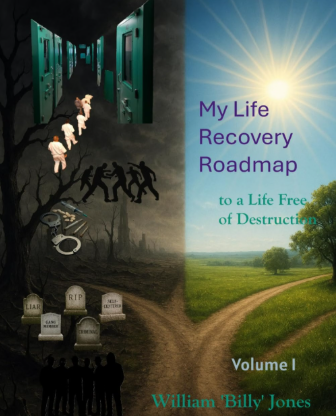
My Life Recovery Roadmap: to a Life Free of Destruction
Author: William 'Billy' Jones ORDER AT AMAZON.COM
The My Life Recovery Roadmap (Vol I of II) is just that, a roadmap from criminality to a life free of destruction. It will guide you through the first three phases of a six phase process of change: Commitment to Change, Cognitive Change, Emotional Change, Social Skill Building, Identity and Purpose, and Relapse Prevention. Using daily journaling exercises and worksheets the reader will examine his or her life and learn cognitive behavior therapy tools that will provide a clear pathway for positive change. Volume I contains the first three phases of a six phase, nine month My Life Recovery Program.
INTRODUCTION
After thirty plus years of incarceration I understand my purpose and calling is to help others change their life. I designed this curriculum for the My Life Recovery Program, a program that meets the needs of the criminal who wants to change but does not know how. I designed it based on what worked for me, and that was a lot of self-reflection and journaling. Journaling allowed me to reflect on what happened, what caused it, how I felt about it, and ultimately my behavior and its consequences.
For myself, I simply attempted to write every memory I possessed and could recall, and this effort was extensive and took two years of writing daily for at least three hours. I desired to tell my life story. But the writing was not my life story, but pages and pages of trauma, pain, and bad decisions. It showed me where I was, but not where I was going. I still needed to do what Director Chris Carter tells all the Residents in the Texas Department of Criminal Justice. I needed to, "turn the page and write a new chapter to my life." Today, I can say I'm doing that. With every conversation, every opportunity, every open door, I help others change. Sometimes its incremental, sometimes it's leaps and bounds, and always it helps people change their lives.
It is my hope Residents will sit down daily and use the workbook to guide them in journaling, examining their life, and applying the cognitive behavior therapy tools which cause lasting change and rehabilitation. Today, other prisoners say I am successful and want to be like me. I say I am blessed with the opportunity to serve others.
Before you can serve others, you must serve yourself. Take a deep dive into your life and learn who you are. Knowing who you are shows you what you need to change. Each of you is uniquely different, but by applying yourself to this process you will not only become successful, but you will become blessed and able to be a blessing to others.
Wish List of Materials Desired for Peer Led Programs
Office/Teaching Supplies
Salmenta assorted color two-pocket plastic folder, 30pack, $40.00, (5 packs)
Bic round stix xtra life, 1.0mm, black ink, 60 pack, $6.00-8.00, (2 packs)
Pen+Gear #2 HB yellow wood pencil, 24 pack, $1.00, Walmart.com (5 packs)
Pen+Gear Composition notebook 80 sheets, b/w or color $1.00 ea., (100 count)
Expo dry erase markers chisel tip $5.00 (5 packs b/w and 5 packs color)
Expo dry erase markers fine tip $5.00 (5 packs b/w and 5 packs color)
Flipside Dry erase board set 12x9 in, 12 pack, $65.00 (10 pack)
Lanyards (Green or yellow) 75 count each color
Paper (typing/printer) count of 10 boxes
Folding table portable heavy duty (6 ft. or longer) 6 count
Folding chairs indoor/outdoor 6 count (300+ lbs. weight limit) 10
Folding chairs indoor/outdoor 6 count (600+ lbs. weight limit) 4
Items are provided for educational programs, graduations and approved special events
Wish List of Materials Desired for Peer Led Programs
Electronic/Technical Supplies
DVD players 6 count
TV (42-75” no large) 4 count
Wireless microphone (hands-free)
Speakers (sound system)
Sound board
GoPro Camera
Adobe Premier editor software (cd)
Computer PC
Ion speaker system
Microphone (portable/rechargeable)
Green screen
Items are provided for portable educational programs into segregated areas, graduations and approved special events